
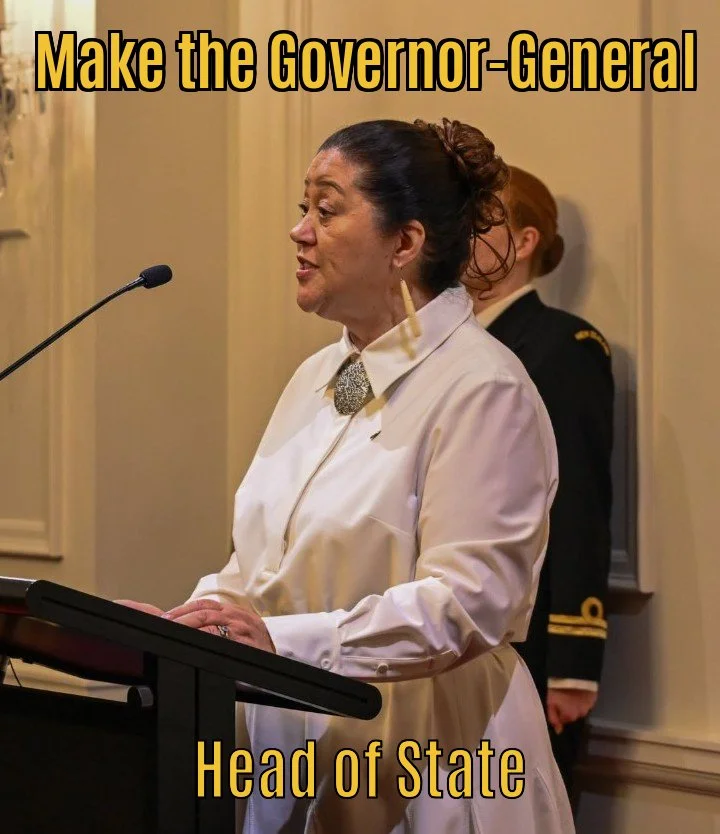
On the anniversary of New Zealand citizenship, we are rebranding our campaign from New Zealand Republic to New Zealand Head of State.
It is the Governor-General who does all the actual work of Head of State and the simplest solution to having an unelected, foreign head of state is to transition the role of Governor-General and make our highest constitutional office what it actually is: The Office of Head of State.
We are doing this today because September 6 is the anniversary of the passing of the British Nationality and NZ Citizenship Act 1948. The constitutional milestone that created New Zealand citizenship.
We assert very simply that only a New Zealander should be eligible to be New Zealand’s Head of State. The office holder should change every five years, and the role should retain the same constitutional, ceremonial and community duties as our Governor-General has now.
Since 1967 we have had New Zealand-born and New Zealand-appointed Governors-General so for 60 years we have been trialling what it means to have our own head of state. Like our Governors-General before them, our Head of State needs to always be someone of outstanding merit and mana. A person with proven dedication to the public good who can represent New Zealand and all New Zealanders with dignity.
Voting rights for citizens and permanent residents are an election issue. While only New Zealand citizens can stand for parliament, NZ First are asserting that voters with Permanent Residence should lose their voting rights after 51 years of having them.
Yet at the same time, our current Head of State, King Charles, is not a citizen, does not live here and never has. The King wields little to no power and the Monarch has for decades been consigned to the role of symbolic figurehead. As a British Sovereign, he is a poor symbol for New Zealand and does no work of any substance or value to New Zealanders.
The Governors-General do not report to the King. As de facto head of state they discharge all functions of New Zealand head of state and act on the advice of ministers from the elected government of the day. The palace does little more than rubber-stamp what is sent from the Governor-General, or from the Beehive via the Governor-General.
The Governor-General’s relationship to the King is tenuous. It is not clear how much regular contact there is between Government House and Buckingham Palace. By convention, the King stays out of New Zealand’s business and has expressed no opposition to us having our own head of state.
The Governor-General who holds ‘the royal prerogative’ and has legal powers to act independently of Government ministers to dissolve parliament, dismiss or appoint a Prime Minister.
The change we propose is not a radical constitutional shift because New Zealand is already one of the world’s most stable, democratic, parliamentary democracies. In every respect except one we are already a parliamentary republic. It is the lack of our own Head of State that is letting us down.
The changes we propose are about taking what we know is working and making it better.
To make it all happen we propose two steps. First, introduce transparency to the selection process for Governor-General. Adopt a system of indirect election via a super-majority in Parliament to select the office-holder instead of the Prime Minister.
Second, define the role’s powers and responsibilities in law as New Zealand Head of State then put to a referendum. Voters choose between staying with a Governor-General selected by parliament or becoming constitutional independent with a democratic Head of State.
It is a simple, elegant, and pragmatic proposal. If the vote is no, we stay with an indirectly elected Governor-General. If it is yes, the incumbent Governor-General becomes Head of State. There would be periodic assessments to check whether the office of our Head of State needed further adjustment or improvement.
Any proposal to change our constitutional laws or conventions deserves scrutiny so before they support change, New Zealanders rightfully want to know more about the reforms we are advocating. In principle, it is a simple solution but in practice voters are wary of potential pitfalls. There is hesitation to make the change or to make it a priority.
We are not advocating for wider change to the parliamentary electoral system, to the way Cabinet or Parliament operate. Having our own Head of State is not about changing the process of Treaty reconciliation or how our laws become laws.
We see no need to change other aspects of our constitution to achieve our own Head of State, and we do not believe in conflating constitutional issues. Safe and steady incremental constitutional change is a better way to do things. New Zealand is stable because we take practical steps to solve real-world problems. We do not grab for ideology and search for upheaval.
The Treaty of Waitangi is not dependent on retaining a British Head of State. It is a treaty between and for New Zealanders and having our own Head of State will help make that clear.
The concept of “the Crown” is not the simplest concept to explain and it is not surprising when people think it refers solely to the King. Few New Zealanders have read the Cabinet manual, which explains that in essence “the Crown” means the permanent authority of the state, enacted in the name of the Head of State, but embodied by the executive government, by ministers and their departments.
We are now focusing far more on the Head of State instead of talking about becoming a republic because the categories of republic are so broad they get in the way of talking specifics. Pointing at the US or at various false and failing republics as an argument against having our own Head of State is a distraction from how New Zealand works in practice.
Every republic is different and each country’s democracy reflects its unique circumstances.
Austria, Iceland and Ireland, are all parliamentary republics where the Head of State has limited constitutional and ceremonial powers, but we are not proposing to copy any other countries. We are proposing a New Zealand Head of State and a distinctly New Zealand-style parliamentary republic.
Despite what objectors say, our stability is not dependent on having a foreign or an aristocratic or an Anglican Head of State. It is because New Zealanders have a well-developed, long-held and widespread commitment to good governance.
From today onwards our website, campaign literature and all our lobbying, advertising and messaging will be about moving towards a NZ Head of State. Our focus is still on principles not personalities and our commitment to involving all New Zealanders in the debate continues. Our commitment to achieving what is fair and pragmatic and in the interests of all New Zealanders remains.
We are looking forward to Waitangi Day 2040 when New Zealand’s Head of State and Britain’s Head of State meet at the Treaty grounds as equals. Representatives of two sovereign countries bound together by our shared historical and our ongoing political, cultural and economic bonds.
Savage is a union director in Auckland and the current chair of NZ Republic / Kia Mana Motuhake a Aotearoa. He was one of the co-founders of the campaign and has been involved since its inception in 1994.